A floor rate you can defend
Not a guess and not a benchmark. Your costs, your capacity, and a number with every step shown, so you can explain it to a client or to yourself.
For people who sell their time
Most people price against 2,080 hours a year. Almost nobody sells 2,080 hours. gomomo works out what an hour of your time actually costs to deliver — then tells you the least you can charge and still be running a business.
Free forever for one business. No card, no trial countdown.
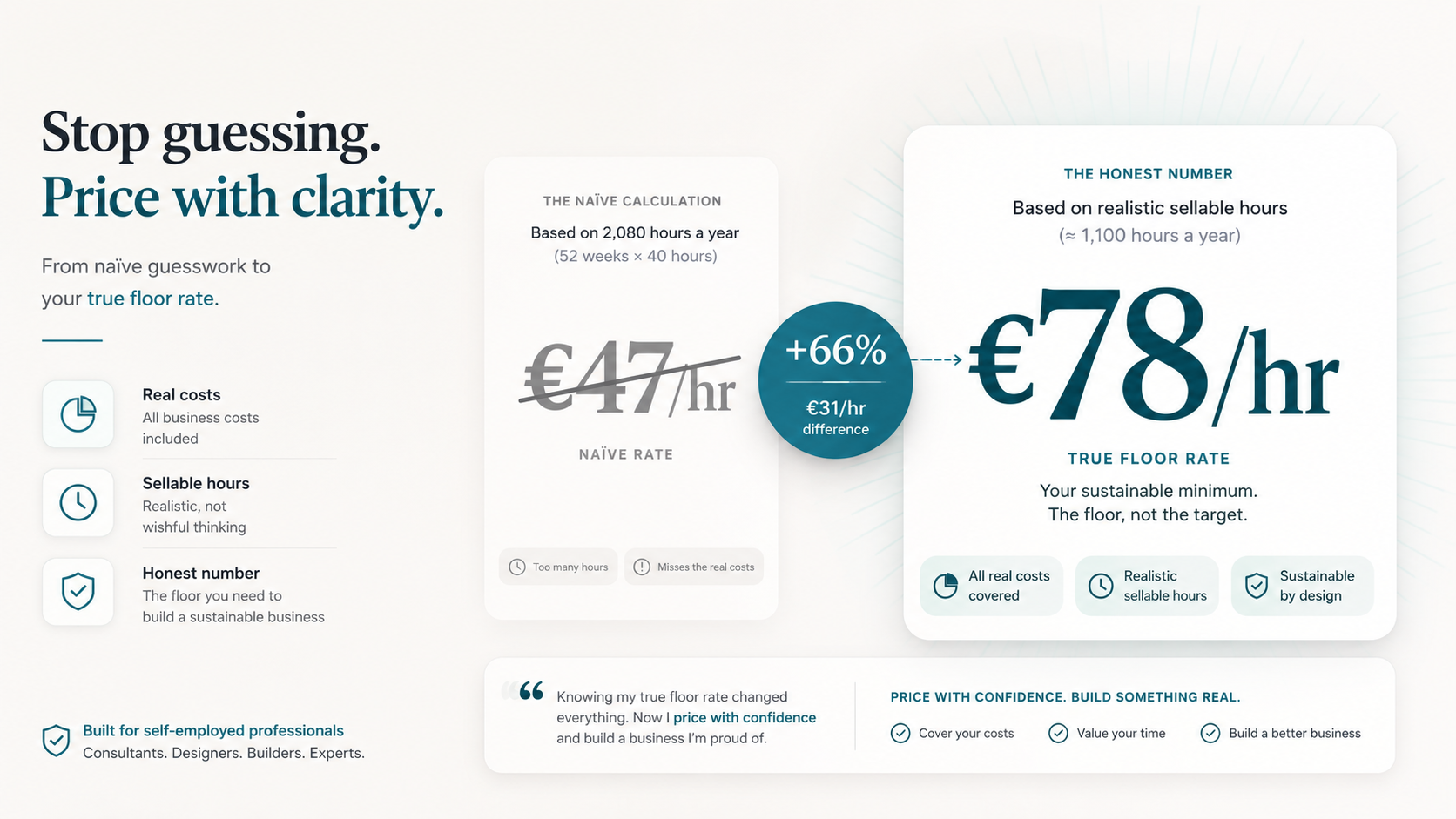
You set your rate early on. Maybe you asked what other people charge, maybe you took the salary you wanted and divided it by something like 2,000 hours. It felt about right, so it stuck.
Since then you have taken on an accountant, a subscription or nine, an insurance policy, a laptop that will not last forever, and a van. You have taken holiday, you have been ill, and you have spent whole days quoting for work you did not win. None of that changed the rate.
So the year ends and the work was there and the money is not, and the honest answer is uncomfortable: some of the jobs you took were priced below what they cost you to deliver. Not by much. By enough.
A rate that was about right three years ago is a rate that is wrong today, and nothing tells you.
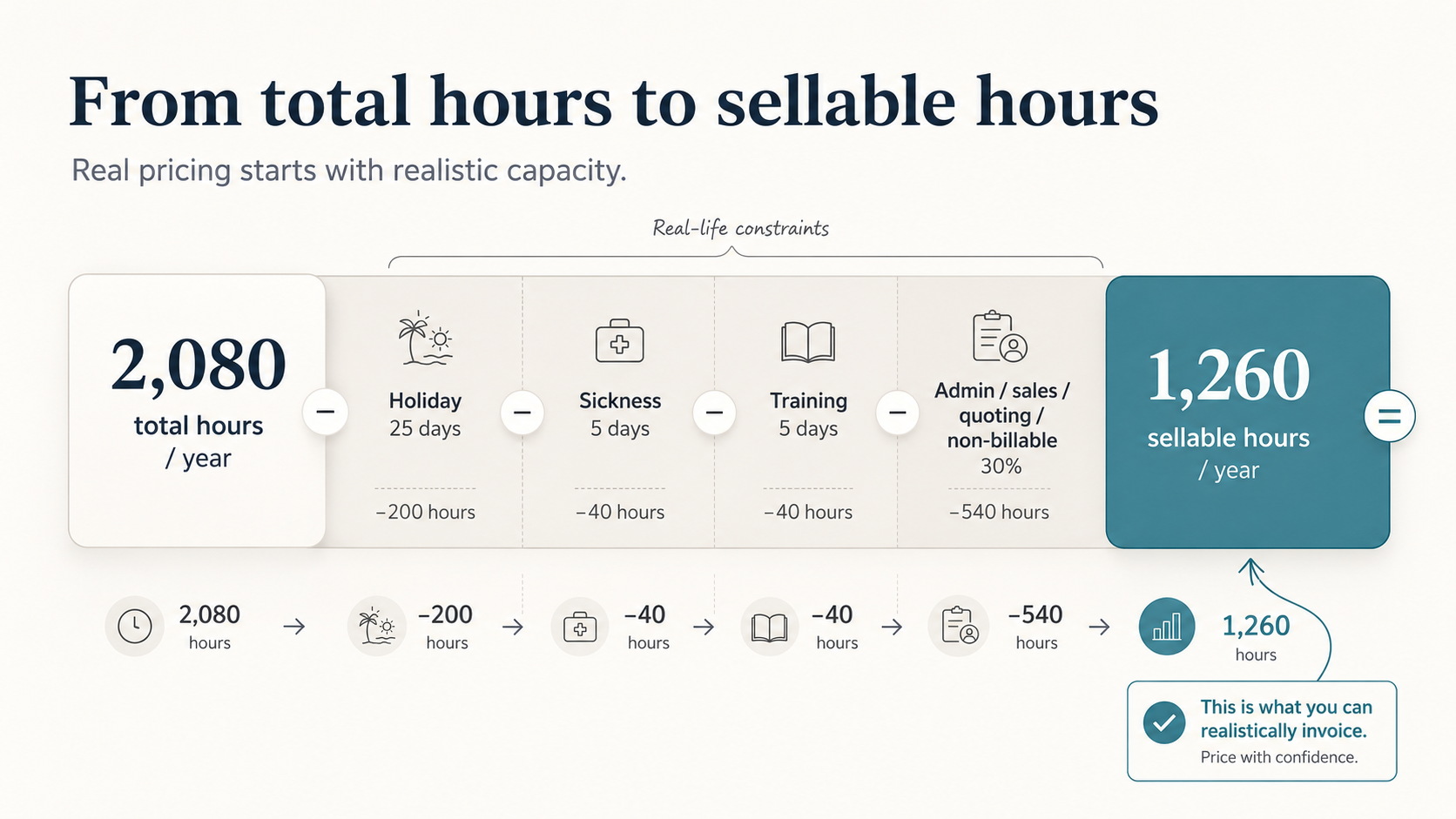
1,260
sellable hours in a realistic year
260 working days, less 25 holiday, 5 sick and 5 training, at 8 hours, with 30% of the rest unsellable. Not 2,080. The calculator below works it out live.
39%
less time to sell than you think
The gap between 2,080 hours and 1,260. A rate set against the first number has to cover a year that is this much shorter than it assumed.
20 minutes
to your first honest number
Onboarding asks for your pay, your fixed costs and your working year. Nothing else is needed for a floor rate.
0
prices calculated in a browser
Every figure comes from one calculation engine in the database, including the estimator on this page.
This is the real calculation, not a marketing approximation — the same database function the product uses, checked against it by an automated test that fails the build if the two ever disagree.
Not what lands in your account. A take-home figure here makes every price too low.
Rent, software, insurance, accountant, phone — everything that leaves the account whether or not you win work.
Quoting, admin, sales, the gaps between jobs. It is real work and no client pays for it. 30% is typical; 0% is never true.
Working it out…
An estimate, because it does not know about your equipment, your team or what you actually sell. Everything it leaves out pushes the real figure up, never down.
The salary the business should pay you before tax, your fixed expenses, and the things you bought once that wear out. It adds the employer costs and the tax reserve that people forget.
Working days, holiday, sickness, training, and the share of your time that is real work but cannot be invoiced. That last one is the number that changes everything.
The floor is what a job must cover to leave you no worse off. What you charge above it is a decision — and the product shows you the margin on every quote before you send it.
Not a guess and not a benchmark. Your costs, your capacity, and a number with every step shown, so you can explain it to a client or to yourself.
Price each thing you sell, then bundle them. The bundle shows what its parts cost separately, so a discount is something you choose rather than something that happens.
Every line carries its cost. You see what the job leaves you before you send it, not after the year ends.
A pay rise, a quiet quarter, an employee. See what each does to the floor rate before it happens rather than afterwards.
Data in the EU. Tax and VAT numbers encrypted. Tenant isolation enforced by the database itself and proved by seven hundred automated assertions, not by careful coding.
English, French, Spanish, Dutch and Greek. Money in minor units end to end, so nothing is ever a rounded-off penny out.
Somebody who sells their own time or a small team’s: a designer, a builder, a consultant, a studio of four. Not an enterprise, not a marketplace, not a bookkeeper. If you have ever quoted a job by feel and wondered afterwards whether it was worth doing, this is for you.
One business, one person, one rate to get right. The free tier covers this permanently.
Different people cost different amounts and sell different hours. The floor rate accounts for that rather than averaging it away.
Accountants and consultants can work inside a client’s books with their own access, and the screen says whose numbers you are looking at.
You will either learn that your rate is fine, which is worth knowing, or that it is not, which is worth a great deal more.